
Reclaiming Your Body After Baby: A Modern Solution for New Mums
Pregnancy is one of the most transformative experiences a woman can go through, but the months that follow often bring an unexpected challenge: a soft, stubborn lower-belly pouch that refuses to budge, no matter how many salads you eat or how often you make it to the gym. If you’ve ever pinched that little roll above your C-section scar and wondered whether anything could really shift it, you’re far from alone.
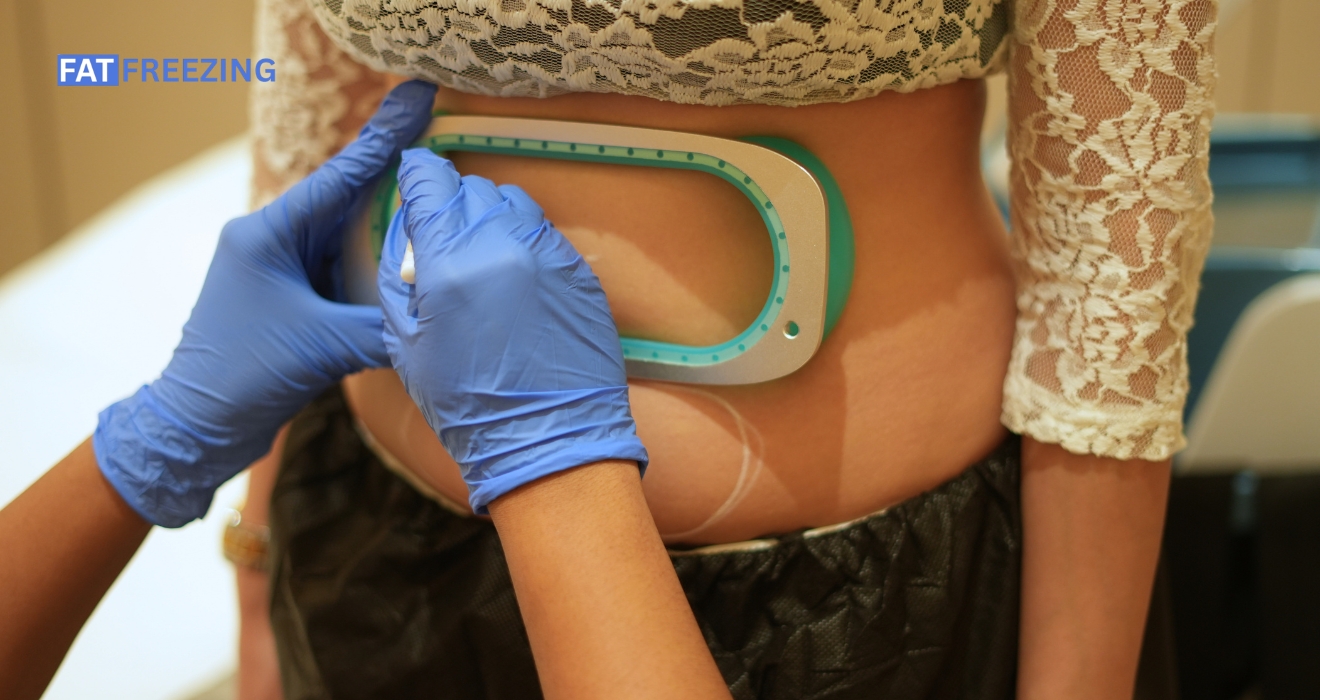
In Mumbai, an increasing number of new mothers are turning to cryolipolysis after pregnancy as a safe, non-surgical way to address localised fat on the abdomen and flanks. Also known as fat freezing, this FDA-cleared technology uses controlled cooling to permanently destroy fat cells without incisions, anaesthesia or downtime, making it particularly appealing to women juggling sleep-deprived nights, feeding schedules and the demands of early motherhood.
This guide explores how cryolipolysis works for the post-pregnancy belly, when it’s appropriate to start, what realistic results look like, and how to integrate it into a holistic recovery plan. We’ll also cover safety considerations specific to new mums, so you can make an informed, evidence-based decision.

What Is Cryolipolysis and How Does It Work?
Cryolipolysis is a non-invasive body contouring technology that exploits a simple biological fact: fat cells are more vulnerable to cold than the surrounding skin, muscle and nerves. During a session, a specialised applicator gently draws a fold of tissue into a cooling chamber and chills it to a precisely controlled temperature, typically between -5°C and -11°C, for around 35 to 60 minutes.
At these temperatures, the lipids inside fat cells crystallise, triggering a process called apoptosis (programmed cell death). Over the following weeks, your body’s immune system gradually clears away the damaged cells through the lymphatic system, and the liver metabolises the released lipids as part of normal processes. The result is a measurable reduction in the thickness of the treated fat layer, without harming the overlying skin.
Studies published in journals such as the Aesthetic Surgery Journal have documented fat-layer reductions of around 15 to 28 per cent in treated areas after a single course of treatment. For a deeper dive into the underlying biology, our explainer on the science behind cryolipolysis and fat freezing walks through the process step by step.
Why It Suits the Post-Pregnancy Belly
The lower abdomen after pregnancy often holds onto a layer of pinchable subcutaneous fat that sits stubbornly above the muscle wall. This is precisely the type of fat cryolipolysis is designed to target. Because the procedure is non-surgical, there are no incisions, no anaesthesia and no recovery period, which is especially valuable for mothers who cannot afford to be sidelined from caring for a young child.
Why Diet and Exercise Aren’t Always Enough
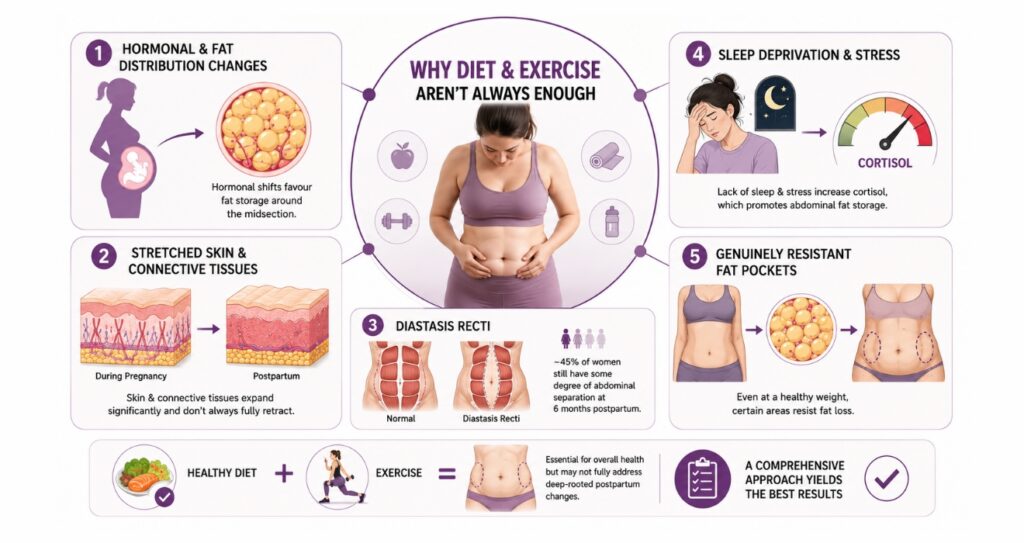
It’s a frustrating truth that many post-pregnancy bellies persist despite healthy eating and consistent exercise. There are several reasons for this:
- Hormonal shifts: Pregnancy alters fat distribution, often favouring storage around the abdomen, and these patterns can linger for months.
- Stretched skin and connective tissue: The skin and linea alba expand significantly during pregnancy and don’t always fully retract.
- Diastasis recti: Around 45 per cent of women still have some separation of the abdominal muscles at six months postpartum, which can create a rounded profile even when fat is minimal.
- Sleep deprivation and stress: Both elevate cortisol, which encourages abdominal fat storage.
- Genuinely resistant fat pockets: Even at a healthy weight, some areas simply respond poorly to general weight loss.
Cryolipolysis offers a targeted, evidence-based way to address that final layer of subcutaneous fat that lifestyle alone cannot shift. It isn’t a weight-loss treatment, and it cannot repair muscle separation or significant skin laxity, but for the right candidate it can make a meaningful difference. If you’ve struggled with stubborn areas before, our article on weight loss challenges and fat reduction solutions explores why some fat is so difficult to shift.
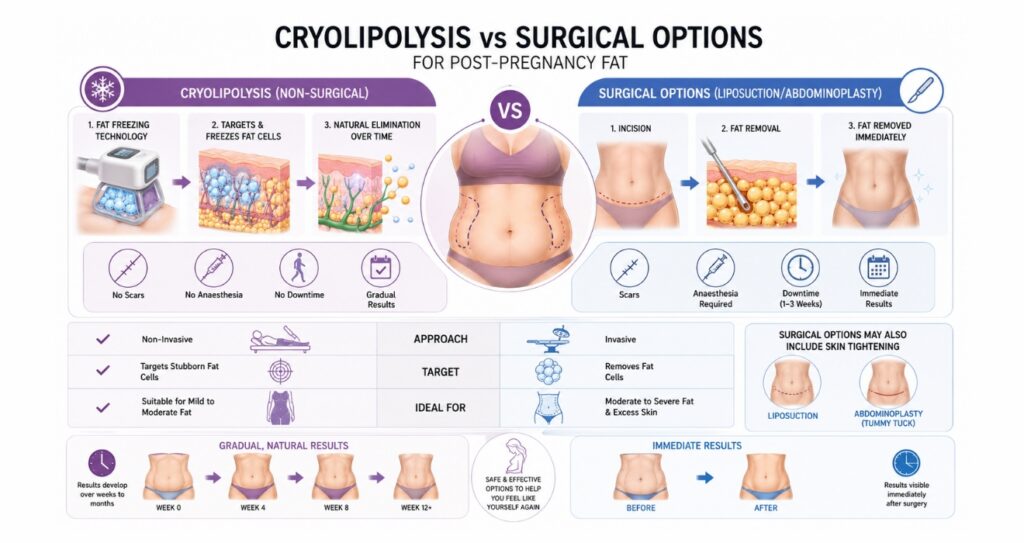
Cryolipolysis vs Surgical Options for Post-Pregnancy Fat
Why New Mums Choose Cryolipolysis
- Completely non-surgical with no incisions, stitches or anaesthesia
- No downtime, so you can return to childcare immediately
- FDA-cleared technology with a strong safety record
- Permanent destruction of treated fat cells
- Natural, gradual results that don’t draw attention
- Significantly more affordable than abdominoplasty or liposuction
- Minimal pain, often described as cold pressure followed by numbness
Important Limitations to Know
- Will not repair diastasis recti or muscle separation
- Does not tighten significantly loose or overhanging skin
- Cannot reduce deeper visceral (intra-abdominal) fat
- Results appear gradually over 8 to 12 weeks, not overnight
- Not suitable while pregnant or breastfeeding
- May require two or three sessions for optimal results
- Rare risk of paradoxical adipose hyperplasia (around 1 in 3,000)
When Can New Mums Start Fat Freezing?
Timing matters enormously when it comes to post-pregnancy fat freezing. Professional bodies including the American Society of Plastic Surgeons advise against cryolipolysis during pregnancy and while breastfeeding, primarily because safety data in these populations is lacking and lactation itself plays a useful role in mobilising fat stores.
Most reputable clinics, including ours, recommend waiting at least three to six months after delivery, and ideally until:
- You have completely finished breastfeeding
- Your weight has stabilised for several months
- Any C-section scar is fully healed and matured
- You’re close to your pre-pregnancy weight, or at least to your realistic goal weight
- You’ve had time to address diastasis recti through physiotherapy if needed
For many women, this means starting to consider cryolipolysis somewhere between six and twelve months postpartum, though every recovery is individual. A thorough consultation is essential to assess whether you’re a suitable candidate.
Cryolipolysis isn’t about reversing motherhood, it’s about helping women who’ve done the foundational work of healing feel a little more at home in their changed bodies.
What Results Can You Expect, and When?
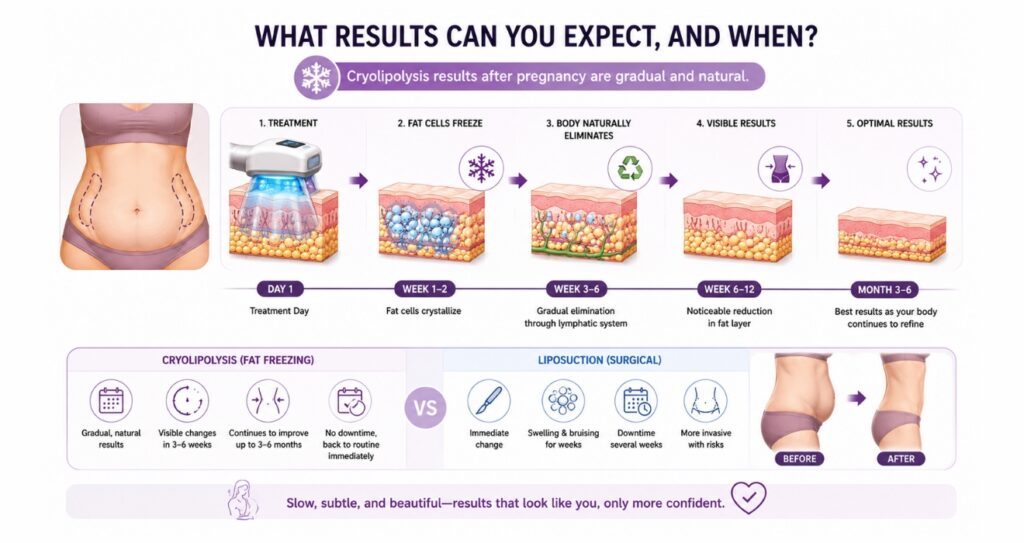
One of the most important things to understand about cryolipolysis results after pregnancy is that they unfold gradually. Unlike liposuction, where changes are immediate (and accompanied by weeks of swelling and bruising), fat freezing delivers a slow, subtle reshaping as your body clears the treated fat cells over several weeks.
Typical Timeline
| Timeframe | What to Expect |
|---|---|
| Days 1 to 14 | Redness, swelling, numbness, mild tenderness; tissue may feel firm |
| Weeks 3 to 4 | First subtle changes; clothes may start feeling looser |
| Weeks 6 to 8 | More noticeable reduction in bulge prominence |
| Weeks 10 to 12 | Near-final results visible; treated area distinctly slimmer |
| Months 4 to 6 | Optimal results, particularly after multiple sessions |
Most women see around a 20 to 25 per cent reduction in the thickness of the treated fat layer per cycle. For a more substantial change, two or three sessions spaced six to eight weeks apart are often recommended. You can read more about treating this region specifically in our guide to cryolipolysis for thighs and abdomen.
It’s worth noting that the fat cells destroyed during treatment are gone permanently. However, the remaining fat cells can still expand if your weight rises significantly, which is why maintenance matters.

Safety, Side Effects and Who Is a Suitable Candidate
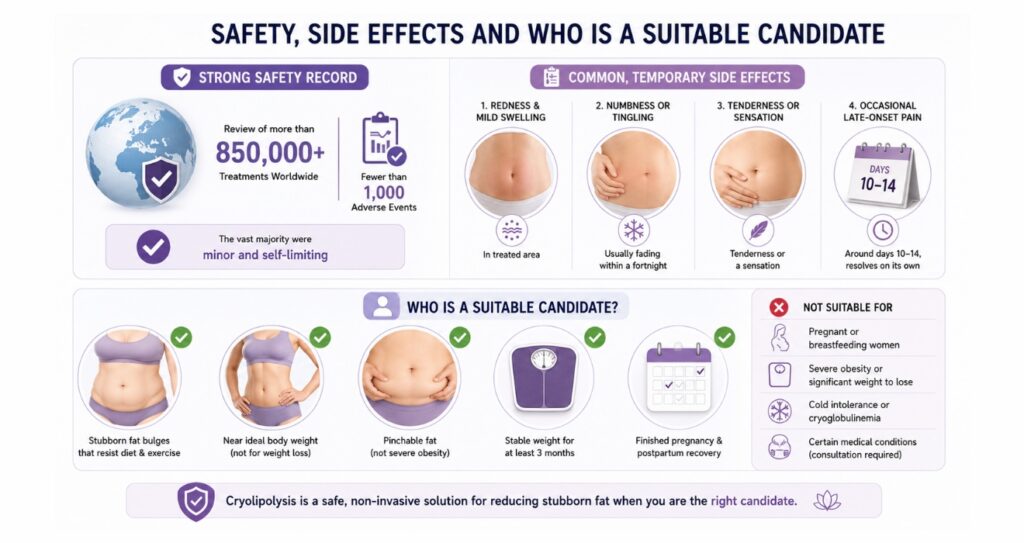
Cryolipolysis has one of the strongest safety records of any non-invasive body contouring technology. A review of more than 850,000 treatments worldwide identified fewer than 1,000 adverse events, the vast majority of which were minor and self-limiting.
Common, Temporary Side Effects
- Redness and mild swelling in the treated area
- Numbness or tingling, usually fading within a fortnight
- Tenderness or a deep-bruise sensation
- Occasional late-onset pain around days 10 to 14, which resolves on its own
Rare but Important Risks
The most discussed rare complication is paradoxical adipose hyperplasia (PAH), where treated fat unexpectedly enlarges rather than reducing. It occurs in roughly 1 in 3,000 treatment cycles and typically requires surgical correction. While uncommon, it’s something every reputable provider should discuss openly during consultation. Our detailed article on fat freezing safety, side effects and risks covers this in more depth.
Ideal Candidates
You’re likely to be a good candidate if you:
- Are at least 3 to 6 months postpartum and no longer breastfeeding
- Have a stable weight near your pre-pregnancy figure (BMI under 30 is ideal)
- Have discrete, pinchable pockets of subcutaneous fat
- Have reasonable skin elasticity
- Have realistic expectations about gradual, moderate change
- Are free from cold-sensitivity disorders such as Raynaud’s or cryoglobulinaemia
When to Wait or Consider Alternatives
Cryolipolysis may not be the right starting point if you have significant diastasis recti, marked skin laxity, an untreated hernia, or are still actively losing weight. In these cases, physiotherapy, skin-tightening treatments or surgical options may serve you better.
Aftercare: Maximising and Maintaining Your Results
One of the joys of cryolipolysis is that aftercare is refreshingly simple. There’s no wound to nurse, no compression garment that’s strictly required, and you can pick up your baby on the way home. That said, certain habits will help you get the most from your treatment.
In the First Week
- Drink plenty of water to support lymphatic clearance
- Walk gently and keep moving; avoid prolonged stillness
- Massage the treated area lightly for several minutes a day if your provider recommends it
- Wear comfortable, lightly supportive clothing
- Use paracetamol for any tenderness; avoid heavy NSAIDs unless advised
In the Following Weeks
- Maintain a balanced diet rich in protein, fibre and whole foods
- Prioritise sleep where possible, as cortisol from sleep deprivation encourages abdominal fat storage
- Reintroduce or continue postnatal-appropriate exercise, including core rehabilitation
- Stay hydrated and limit ultra-processed foods
Because the destroyed fat cells don’t return, sustaining your results comes down to preventing the remaining cells from enlarging. Our guide on maintaining weight loss after non-surgical fat reduction offers practical strategies that work well alongside the realities of new motherhood.
Don’t Forget the Core
If diastasis recti is part of your post-pregnancy picture, no fat-freezing treatment will close that muscle gap. Working with a women’s health physiotherapist on deep core engagement, breath coordination and pelvic floor recovery is invaluable, and it complements cryolipolysis beautifully when both are appropriate.
Cost and What to Expect at Fat Freezing Clinic Mumbai
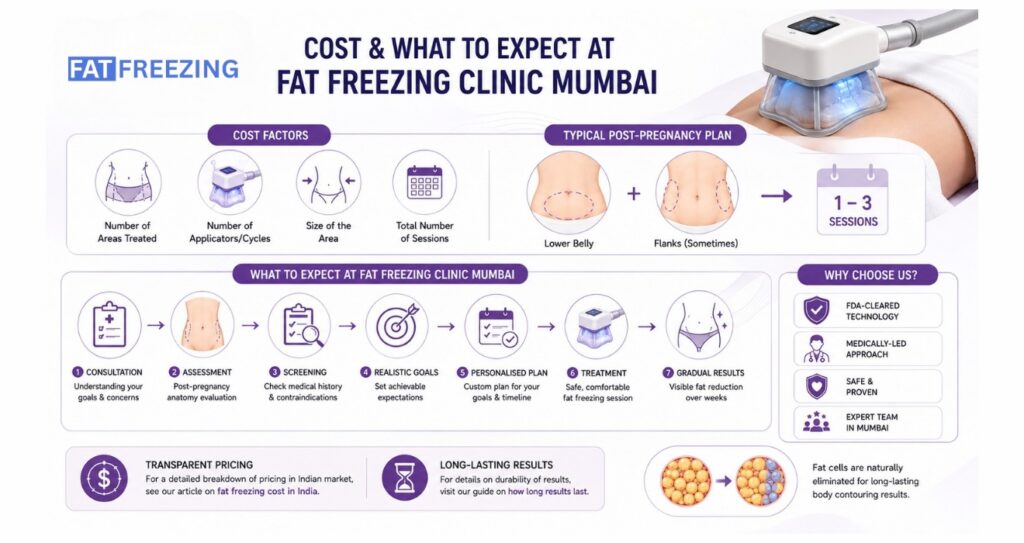
Cryolipolysis in Mumbai is significantly more affordable than in North America or Europe, though pricing varies based on the number of applicator cycles required, the size of the area treated and the total number of sessions. A typical post-pregnancy abdominal plan involves treating the lower belly and sometimes the flanks across one to three sessions.
At Fat Freezing Clinic in Mumbai, we use FDA-cleared cryolipolysis technology and take a careful, medically-led approach to every consultation. We assess your post-pregnancy anatomy, screen for contraindications, set realistic expectations and design a plan that fits your goals and timeline. For a transparent breakdown of pricing in the Indian market, see our article on how much fat freezing costs in India, and for details on durability of results, our guide to fat freezing treatment in Mumbai explains how long results typically last.
Ready to Take the Next Step?
Motherhood changes the body in profound ways, and there’s no obligation to undo any of it. But if a stubborn lower-belly pouch is affecting how you feel in your clothes and your skin, and you’ve done the foundational work of healing, eating well and rebuilding your strength, cryolipolysis can be a thoughtful, low-risk way to refine your contour without surgery.
Book a consultation at Fat Freezing Clinic Mumbai to discuss your goals, examine your candidacy and explore a personalised treatment plan. Every journey is different, and we’ll help you decide whether non-surgical belly fat reduction is the right next step or whether a different approach would serve you better.
How soon after giving birth can I have cryolipolysis?
Most clinics recommend waiting at least three to six months after delivery, and ideally until you’ve finished breastfeeding and your weight has stabilised. This allows your body to complete its natural postpartum recovery and gives more predictable, lasting results from treatment.
Is fat freezing safe while breastfeeding?
No, cryolipolysis is not recommended while breastfeeding. Safety data in lactating women is lacking, and breastfeeding itself helps mobilise fat stores naturally. Most reputable clinics, including Fat Freezing Clinic Mumbai, will ask you to wait until nursing has fully concluded before treatment.
Will cryolipolysis fix my diastasis recti or loose skin?
No. Cryolipolysis only targets subcutaneous fat. It cannot close abdominal muscle separation or tighten significantly loose skin. For diastasis recti, postnatal physiotherapy is essential, and skin laxity may require radiofrequency, microneedling or surgical options to address effectively.
How many sessions will I need for my post-pregnancy belly?
Most new mums need between one and three sessions per area, spaced six to eight weeks apart. The exact number depends on the volume of fat, your goals and how your body responds. Your provider will recommend a personalised plan during your consultation.
When will I see results from fat freezing after pregnancy?
Initial changes typically appear at three to four weeks as your body clears the treated fat cells. More noticeable improvements emerge between six and eight weeks, with near-final results visible at 12 weeks. Optimal outcomes are usually seen between three and six months post-treatment.
Does cryolipolysis hurt, and is there any downtime?
Discomfort is minimal. You’ll feel intense cold and pulling for the first few minutes, after which the area goes numb. There is no downtime, so you can return to caring for your baby immediately. Mild redness, swelling or tenderness may last a few days to a fortnight.
Can cryolipolysis remove visceral or deep belly fat?
No. Cryolipolysis only treats subcutaneous fat, the pinchable layer beneath the skin. Visceral fat, which surrounds internal organs and contributes to a rounded abdominal profile, can only be reduced through diet, exercise, sleep and overall lifestyle changes, not external cooling devices.
Will the fat come back if I have another baby?
The fat cells destroyed by cryolipolysis don’t regenerate, but a future pregnancy will stretch your abdomen again and may alter fat distribution. Many women choose to complete their families before investing significantly in body contouring, though earlier treatment is still safe and effective.
How much does cryolipolysis cost in Mumbai?
Costs vary depending on the number of applicator cycles and sessions required, and pricing is typically quoted after consultation. Treatment in Mumbai is considerably more affordable than in the UK or US. Visit our blog on fat freezing cost in India for a transparent overview of typical pricing.
Is cryolipolysis better than liposuction for the post-baby belly?
It depends on your situation. Cryolipolysis is non-surgical, has no downtime and suits women with modest, localised fat. Liposuction removes more fat in one go but involves anaesthesia, incisions and recovery. For significant skin laxity or diastasis, abdominoplasty may be the most comprehensive option.

 WhatsApp
 Call Now
 Consultation